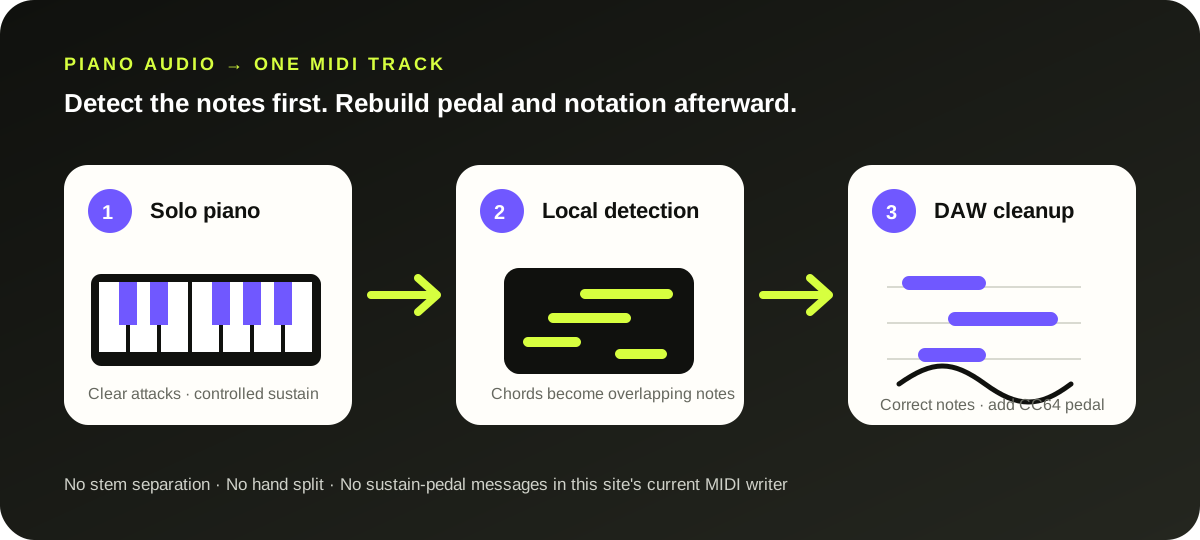
Start with a solo-piano recording and expect an editable draft. This browser tool detects chords and individual notes locally, then exports one .mid track. Sustain pedal, room sound and overlapping resonance can still require cleanup.
The downloaded file is one editable MIDI track. The current writer does not create sustain-pedal messages or separate left and right hands.
WHAT SURVIVES THE CONVERSION
Notes survive. Piano mechanics do not.
The browser down-mixes the recording to mono, resamples it to 22,050 Hz and estimates overlapping note starts, pitches and durations. It maps detected strength to MIDI velocity and writes one standard MIDI track. That makes the result editable, but it is not a performance capture from the piano's sensors.
The file does not preserve hammer, microphone or room tone. It also does not contain separate left- and right-hand tracks or sustain-pedal CC64 messages. If pedal resonance keeps strings sounding after the keys are released, the detector may represent that energy as longer or overlapping notes instead.
Primary references: Spotify Basic Pitch documents polyphonic, single-instrument transcription, mono down-mixing and 22,050 Hz resampling; this site's output behavior is verified against its local app.js MIDI writer.
A PIANO-SPECIFIC CLEANUP ORDER
Fix overlap before you quantize.
01
Check the chord
Compare every dense voicing with the recording before changing timing or velocity.
02
Trim false overlap
Shorten notes that ring beyond the musical release because of pedal or room resonance.
03
Add pedal deliberately
If the performance needs sustain, draw CC64 in your DAW; this download does not include it.
04
Quantize lightly
The tempo slider writes metadata only. Preserve intentional rubato unless a grid is required.
ONE TRACK, CLEAR LIMITS
Know what the MIDI file contains.
The local implementation is the source of truth for this output—not features another converter may offer.
✓
Overlapping MIDI notes Polyphonic detection can place chord tones together in one track.
✓
Timing and approximate velocity Each detected note receives a start, duration and velocity value.
×
Sustain-pedal CC64 No pedal controller messages are written; add them after import if needed.
×
Separate hands or staves Left and right hand are not classified or split into different tracks.
QUESTIONS, ANSWERED
Piano audio to MIDI FAQ
Can this converter detect piano chords?
Yes, the model supports overlapping pitches, so a clean solo-piano chord can become several simultaneous MIDI notes. Dense voicings, pedal resonance and room reflections can still add or hide notes, so compare the result with the recording.
Does it preserve sustain pedal?
No. The downloaded file contains note events but no CC64 sustain-pedal messages. Pedaled audio may influence detected note lengths; add or redraw pedal automation in your DAW after correcting the notes.
Will left and right hands be separated?
No. Both hands are merged into one MIDI track. You can split the track by pitch as a starting point, but crossed hands and inner voices need musical judgment.
Is the output ready for sheet music?
Not necessarily. The on-page score is a quick preview, not engraved notation. Import the MIDI into notation software, then correct rhythm spelling, measures, key signature, voices, ties and staff assignment.
Should I use a digital or acoustic piano recording?
Use the cleaner source. A digital piano's line output often has less room noise, while a well-miked acoustic piano can also work. This is not a specialized piano-only model, so source isolation and clear attacks matter more than the instrument label.